For startups
For startups that would rather ship than manage
Founders, designers, engineers, ops. Everyone is busy, nobody wants to maintain a project tool, and nobody should have to ask “any update?” to find out what slipped.
How do startups use Pinok?
For a startup of 2–20 people, Pinok replaces the status meeting. Each person opens Needs you to see what is theirs, founders open Following to see what is stuck, and anyone captures a task in one sentence from their phone.
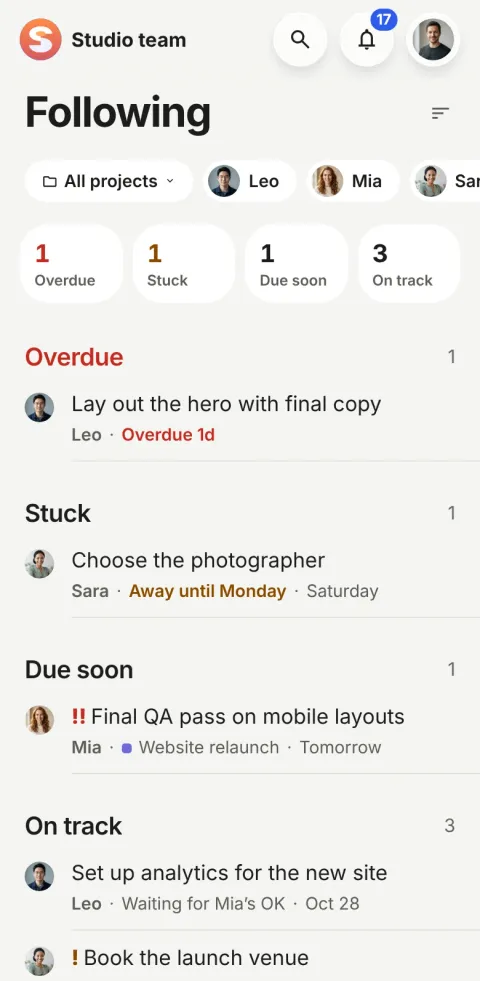
A week at a twelve-person startup
-
Monday
No standup. The founder opens Following: one overdue, one stuck (“Quiet for 4 days”), three on track. One question in one comment, not a meeting.
-
Tuesday
The investor update needs numbers. She hands it to finance with a reply-by day and stays the owner.
-
Wednesday
The release is blocked by the App Store review. The engineer marks it “Blocked by App Store review · check Thu” and moves on.
-
Thursday
The check date comes and the task is back in his Needs you. Approved by Apple; he checks it off.
-
Friday
The Projects tab shows each face in a ring of how much of their week is done. Nobody wrote a status report.
A made-up team, using the app as it works today.
What startups get from it
-
One owner per task
No “we” tasks. Someone has it, and everyone can see who.
-
Capture in a sentence
“Renew the domain Friday #ops @sara !” from the phone, in the hallway.
-
Stuck surfaces itself
Three quiet work days and a task shows up as stuck. Nobody has to ask “any update?”.
-
Private until shared
Personal tasks stay yours; team work is visible to the people on it.
Questions, answered
What is the best Asana alternative for a startup?
For a startup under 20 people that wants to know who has what and what is stuck without maintaining a system, Pinok is built for that, and it’s free for up to 5 people. If you need roadmaps, timelines and integrations, Asana, ClickUp or Linear (for engineering) will serve you better.
Is it good for engineering work?
For issue tracking with sprints and pull requests, a tool built for engineers like Linear is the better choice. Pinok covers the rest of the company’s work: ops, design, marketing, hiring, fundraising.
What happens when we grow past 20 people?
Pinok is built to work from 1 to 20+ people without a redesign. Teams much larger than that usually need the planning and reporting tools that bigger platforms offer.
Compare, and other teams
- Pinok vs Asana Asana is built to run work across a whole company. Pinok is built for one small team that wants less to manage. Here is an honest look at both.
- Pinok vs Todoist Todoist is one of the best personal task managers there is. Pinok keeps the simplicity and builds the team into the core.
- For agencies Client work that changes hands with a note, approvals for sign-off, nothing waiting unseen.
- For studios Reviews in one tap, files on the task, and who is at capacity at a glance.
Get started
Give your team a task. Leave the chasing to Pinok.
Less setup. Fewer follow-ups. A clearer way to get things done together.
Free for small teams · iPhone, Android and the web · Teams of 2–20
Get Pinok